ADCP
Velocity data demonstrates expected current behaviour (Figure 3), with velocities much larger in the Eastward and Northward directions than in the upward direction. The lack of significant apparent velocity in the vertical direction indicates that there is no systematic bias in the beam-frame Doppler velocities.
In addition, the observed velocity signals (large blue and red patches) vary on timescales between days and weeks, which is expected.
Of particular interest, it can be seen around 6th June, the prevailing current changed from South-Easterly to North-Westerly over the course of around two days.
This corresponded with a sudden increase in scatter density, thought to be an indication that the seabed was disturbed by the changing current.
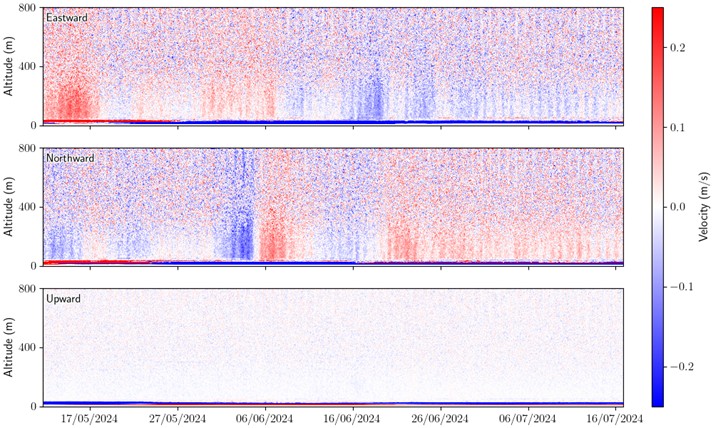
Figure 3: Components of the Earth-frame velocities for the 66-day deployment (60-ping ensembles).
Low scatterer concentration in the deep waters (>2000 m) of the Gulf of Mexico reduced the effective profiling range of the Origin 65 from its achieved maximum range of > 800 m. However, with a sufficiently long averaging period it can been seen that the current velocity signal is present for the entire 800 m range of the Origin 65 (Figure 4).
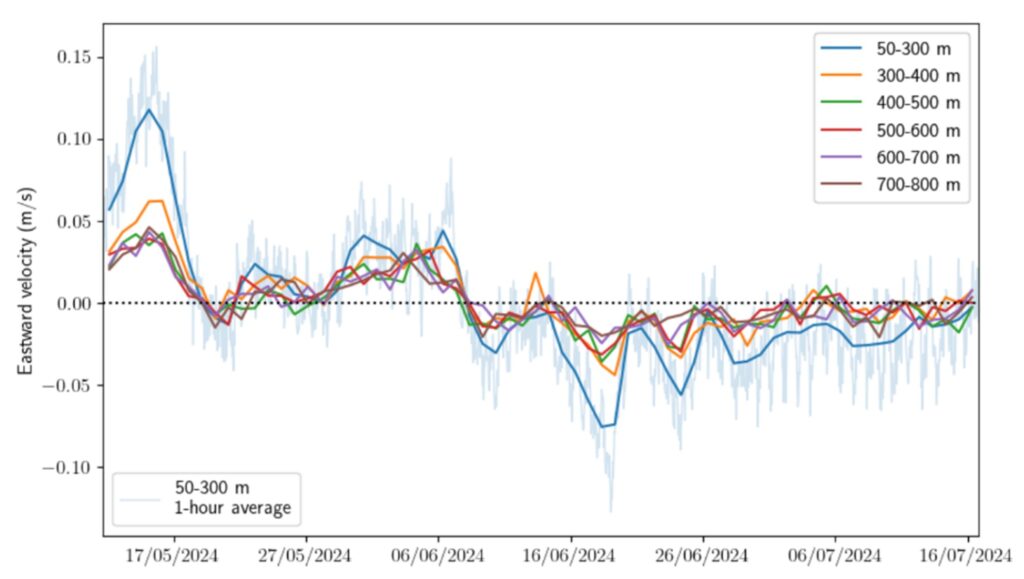
Figure 4: Comparison of 24-hour averages of Eastward current velocity for different altitude bins. Performing increased averaging shows that a consistent current velocity signal is exhibited across the 800 m range of Origin 65.
“Our collaboration with the University of Rhode Island has been instrumental in augmenting our PIES technology in the form of Origin 65, a combined ADCP and PIES, for oceanographic study of geostrophic currents fields like that found in the Gulf of Mexico. We’re delighted to see Origin 65 being applied in this vital study, and by extension, to be able to support research efforts to improve and extend forecasting of the LCS and LCE behaviour with the accuracy desired. We look forward to continuing our relationship with the University of Rhode Island, and to seeing further successful USV data harvests from the Origin 65 units over their deployment period in the Gulf of Mexico.”
Michelle Barnett, Business Development Manager – Ocean Science, Sonardyne
What’s more, evidence of diel plankton migration is apparent with the repeated appearance and disappearance of a scattering layer between 500 m and 800 m height above the bottom. This pattern has a period of roughly 24 hours with the scattering layer clearly visible in daylight hours, as is consistent with the cycle of diel vertical migration observed ubiquitously in aquatic systems throughout the world.
This is nicely demonstrated in cross-correlation data, where values increased to around 80% on a daily cycle in response to the plankton migration (Figure 5). This cross-correlation data helps to indicate the effective maximum range of the system of around 800 m.
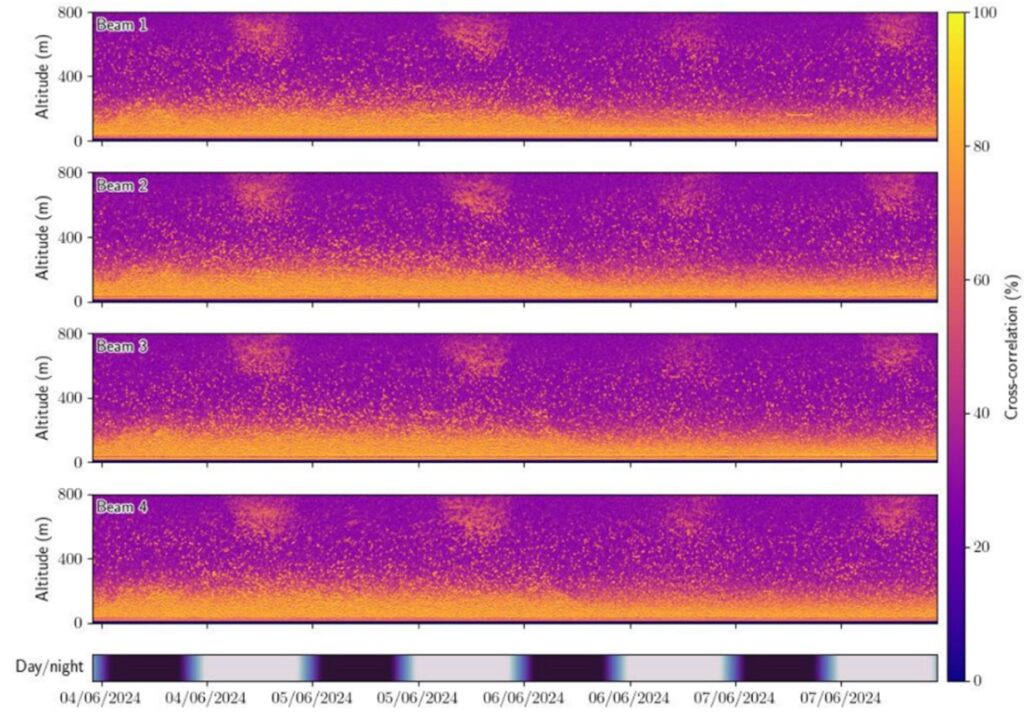
Figure 5: An excerpt (4 – 7th June) of unaveraged cross-correlation data for each of the four beams of the Origin 65 demonstrating a clearly observable diel vertical migration pattern. The lower plot represents the local time, with the colour being a function of the local solar altitude.
“This suite of instrumentation and platforms will help refine predictive tools for future applications in the Gulf. Looking ahead, the combination of Sonardyne Origin 65 current profilers and adaptive data-harvesting technology opens the door for long-term deployments in deep water – anywhere in the world. This is very exciting: we could access remote and critically important regions supporting sustained observations and advancing science.”
Professor Kathleen (Kathy) Donohue, Professor of Oceanography, University of Rhode Island
What’s next?
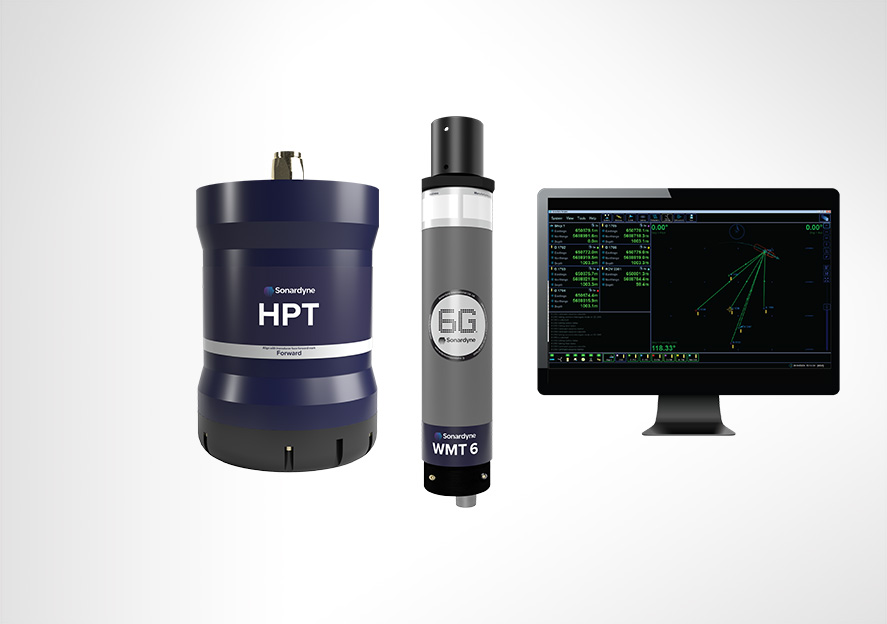
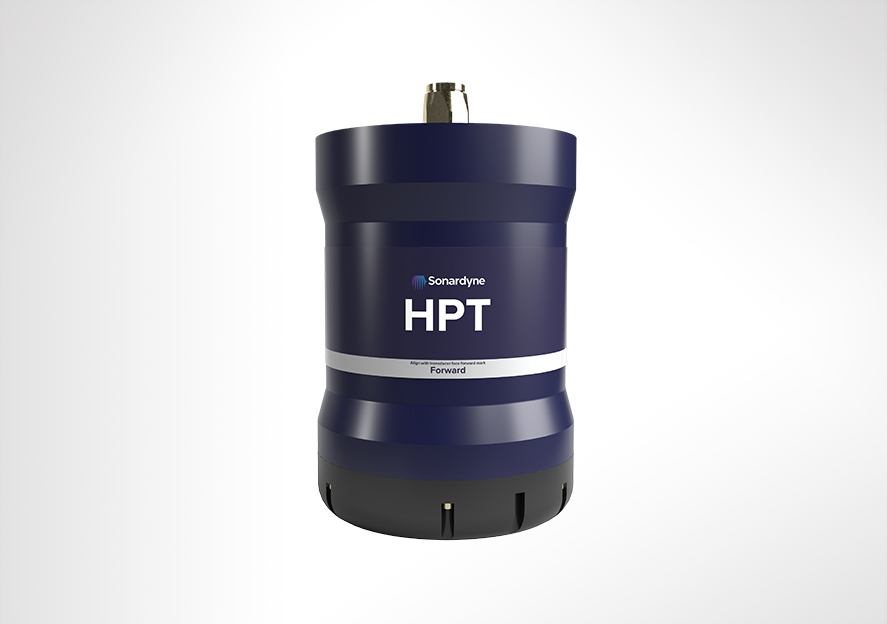
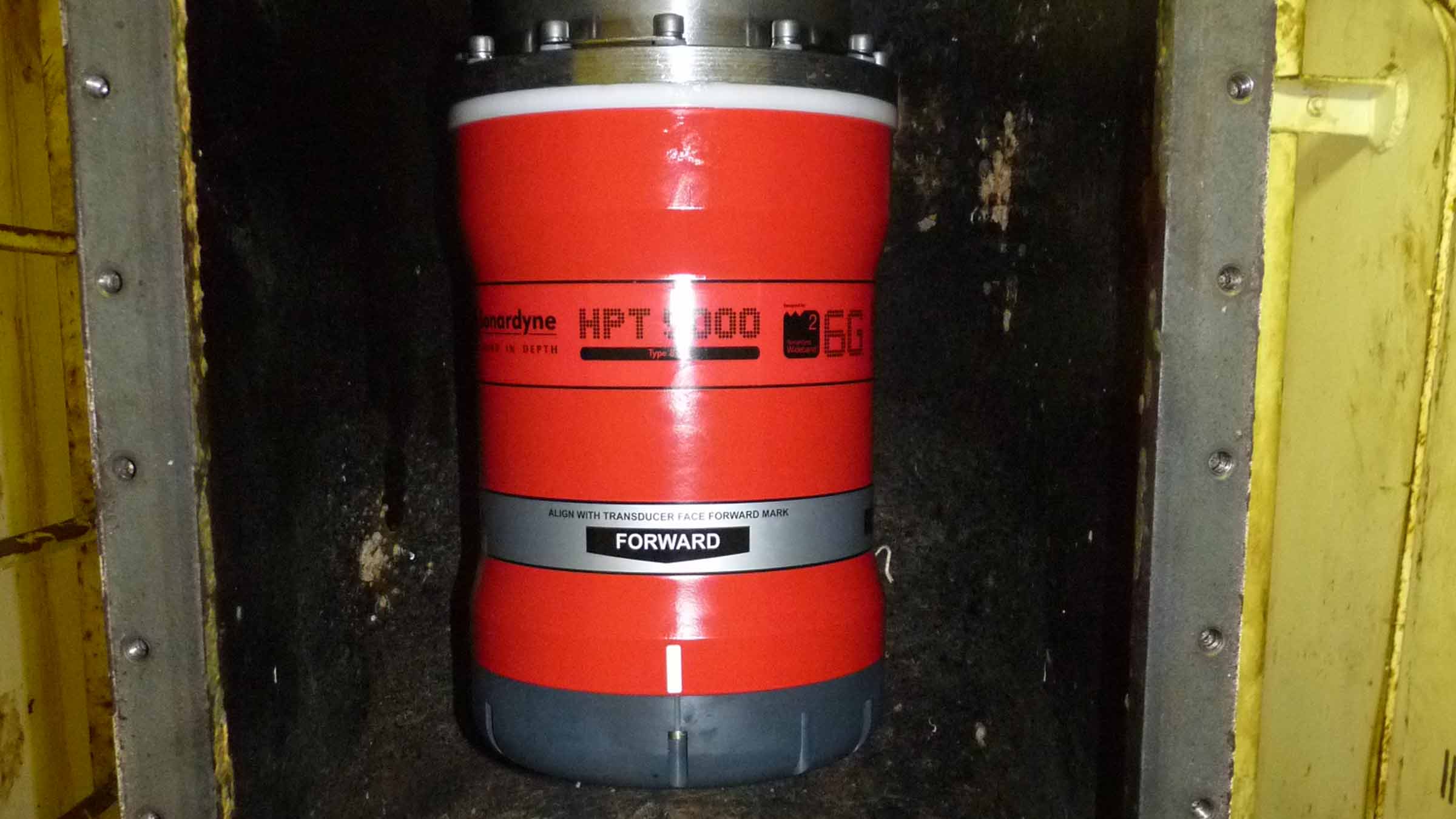
Two successful data harvests by a SeaTrac SP-48 USV equipped with a Sonardyne HPT 7000 L transceiver head have already been conducted. A third data harvest is scheduled for the end of July and the instruments will be recovered in September 2025. Keep an eye on our website and social media for further information about this and the data captured.
If you have an operational challenge for Origin 65, or any other Sonardyne product, please contact us.