Support Centre

Author:

Elaine Maslin

Seabed monitoring systems installed for UK’s first commercial-scale offshore CCS project 

10112026

Sonardyne, a Kraken Robotics company, has successfully started baseline environmental and passive seismic monitoring at the UK’s first commercial-scale offshore carbon storage project.

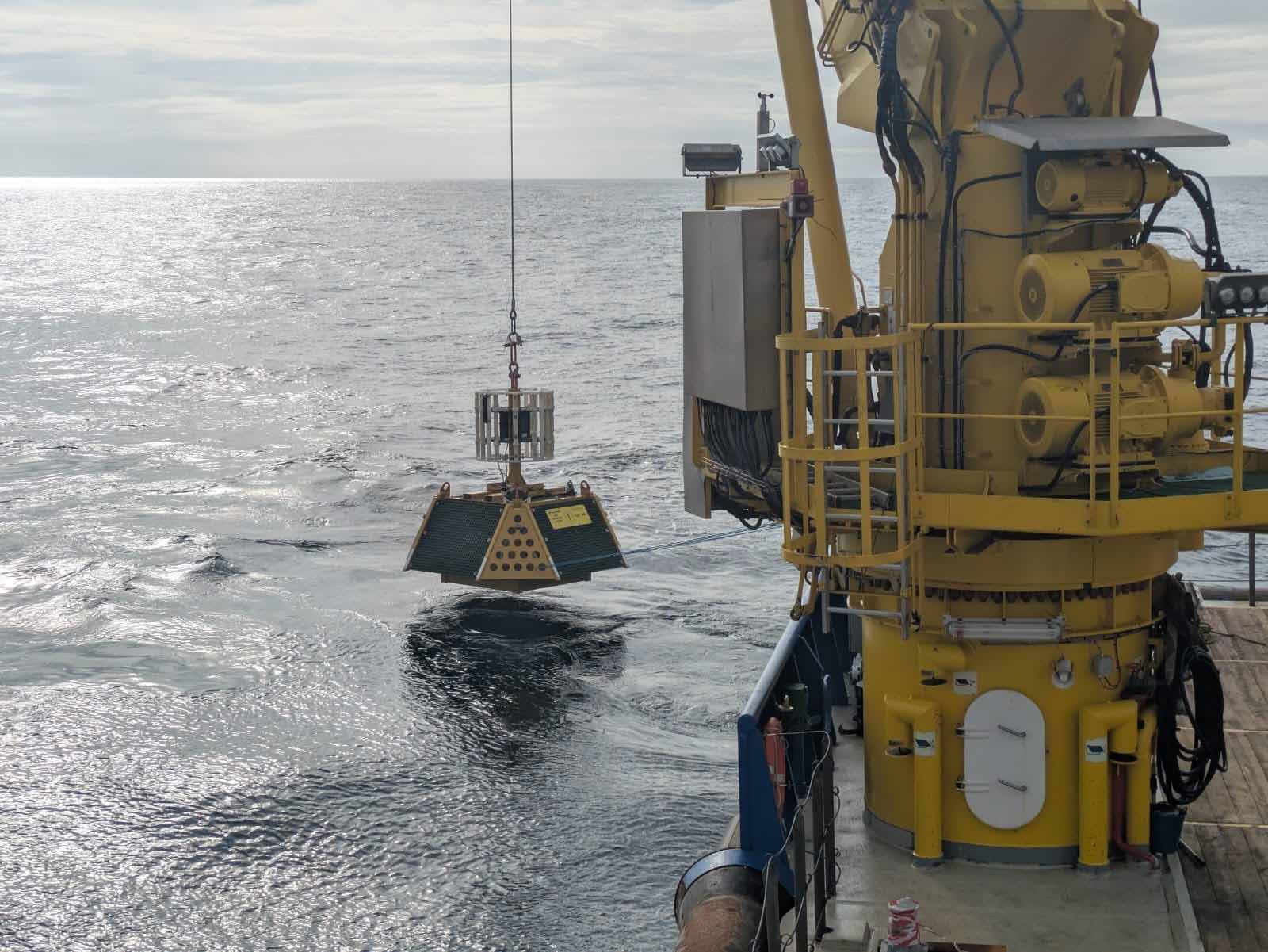
The start of monitoring follows the successful deployment, on behalf of the Northern Endurance Partnership (NEP), of six seabed lander systems at the Endurance CO₂ store, in the Southern North Sea, about 150 km off the coast of Teesside. 

NEP is delivering CO₂ transportation and storage infrastructure centred on the Endurance store, which is about 1,000 m beneath the seabed, as part of the East Coast Cluster decarbonisation programme across Teesside and the Humber. 

The monitoring landers will support NEP’s long-term measurement, monitoring and verification (MMV) programme for offshore CO₂ storage by helping establish the robust, repeatable data needed to monitor the reservoir integrity effectively over time. 

The deployment includes three advanced, autonomous environmental monitoring landers, designed and built by Sonardyne, together with three co-located TIAMAT passive seismic monitoring systems from K.U.M. 

Together, they are collecting baseline data on seawater chemistry, currents, seabed conditions and passive seismic activity before future CO₂ injection operations begin. This will support continued monitoring across the storage lifecycle. 

Wireframe diagram of oceanographic equipment, showing a Passive Seismic Node and a larger system with a Passive Sonar Array, Origin 600 ADCP, and Modem 6, all labeled in green text.
Wireframe models of two complex underwater sensors on a blue grid background, with a list of monitored parameters: CO2, pH, Nitrates, Salinity, and Dissolved oxygen.
Two scientific devices on a grassy underwater seabed. One is a large orange and green pyramid with a cylindrical top, the other is a smaller red and gray rectangular device.
Three large, yellow and white Sonardyne CCS Monitoring Landers, numbered 1, 2, and 3, are shown in a warehouse. Each unit has a trapezoidal base and a cylindrical top structure, with labels indicating 'Pump & Battery Disconnected'.
An illustration of an offshore operation showing two ships and a satellite connected to underwater facilities and a glowing orange seabed deposit via a network of lines.

“This is a significant moment for Sonardyne and NEP,” says Stephen Auld, Business Development Manager for Custom Projects at Sonardyne. 

“Confidence in offshore CO₂ storage starts with good data. By delivering and deploying these environmental and micro-seismic monitoring systems, and managing their ongoing operation and data retrieval, Sonardyne is supporting a key part of NEP’s MMV programme at Endurance.”

“For offshore CO₂ storage, that continuity matters. Long-term assurance depends on reliable data gathered across the full storage lifecycle, not a single point-in-time measurement — a role that draws directly on our experience in seabed-resident monitoring, acoustic communications and offshore integrity monitoring.” 

Mike Stephen, Head of Technical at NEP:

“The deployment of these monitoring systems is a great example of the expertise and innovation that is helping to deliver CCS in the UK.

“Establishing a robust environmental and seismic baseline before operations begin, is a vital part of our long-term monitoring programme, providing the data required to demonstrate the safe and secure storage of CO₂ over time.

“Working with leading technology partners builds confidence in offshore carbon storage and, is helping us to deliver the infrastructure needed to decarbonise industry across Teesside, the Humber and beyond.”

Sonardyne’s environmental monitoring landers are designed to stay on the seabed for long periods. They use onboard power management, Edge data processing and wireless underwater communications to operate remotely and send data back from the seabed to the sea surface. 

This means data can be collected and recovered over time without regularly recovering the landers, supporting the repeatable evidence needed for measurement, monitoring and verification at Endurance. 

Read a longer feature on Sonardyne’s role in the NEP project in Offshore Magazine here.