

Sonardyne
Support Centre

Author:

Andre Moura Vice President, Brazil, Sonardyne

Why Brazil’s subsea market needs more intelligence between inspections 

22092026

Brazil’s deepwater assets need reliable data in support of inspection campaigns. Long-duration subsea monitoring can help operators understand asset behaviour earlier, reduce vessel time, improve safety and support better inspection planning, says Sonardyne’s Brasil Vice President Andre Moura.


Working in Brazil, I see every day how demanding this offshore market is, and how quickly it is changing. Our industry works in deep water and pre-salt fields, far from shore, with high-value subsea infrastructure that has to operate safely for many years.

At the same time, operators are under pressure to improve efficiency, reduce environmental impact and keep people away from hazardous offshore work wherever possible.

Operators and service companies in Brazil already understand the value of inspection. Remotely operated vehicle (ROV) campaigns, survey vessels and integrity programmes are essential, but inspection is often only a snapshot. It can show that something has changed, but not always when the change started, how fast it developed, or what happened between campaigns.

That is where I see a clear opportunity. Brazil’s operators can use long-duration monitoring to build a more continuous picture of how subsea assets are behaving. This is part of a wider move towards intelligent subsea sensors, wireless underwater communications and uncrewed surface vehicles (USVs). USVs can help collect or retrieve data with less reliance on conventional vessel campaigns, helping to reduce carbon emissions and the exposure of personnel to offshore hazardous environments.

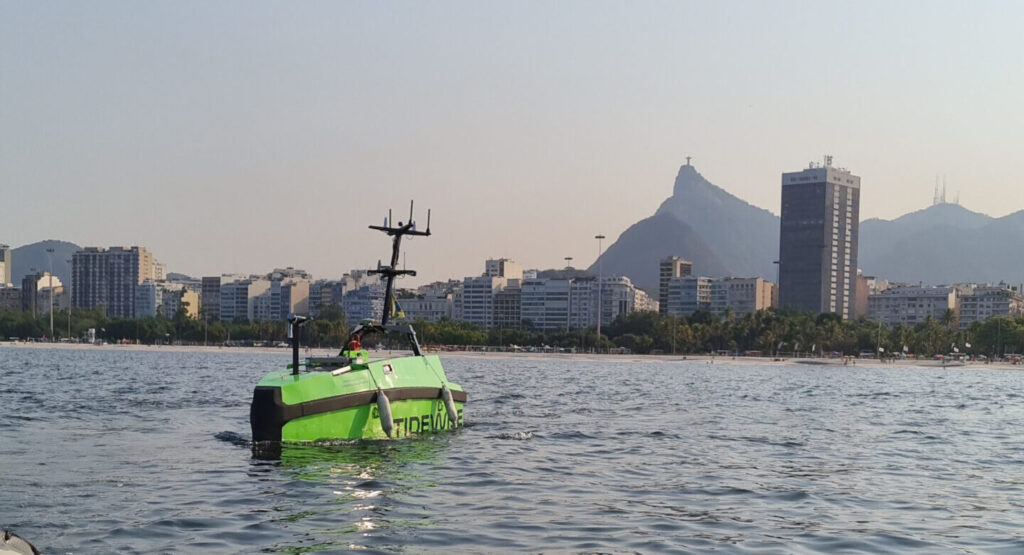
A green and black autonomous surface vessel (ASV) floats on water with the Rio de Janeiro skyline, mountains, and Christ the Redeemer statue in the background.
A green and black autonomous vessel named TIDEWISE is lifted against a blue sky, showing its propellers and a red sensor on the underside.
USBL being used on a USV to track underwater AUVs
A green and black autonomous surface vessel (ASV) floats on water with the Rio de Janeiro skyline, mountains, and Christ the Redeemer statue in the background.
A green and black autonomous vessel named TIDEWISE is lifted against a blue sky, showing its propellers and a red sensor on the underside.
USBL being used on a USV to track underwater AUVs

Brazil is already a risk-based market. Safety, reliability, environmental protection and production continuity are always important. Brazil’s National Agency of Petroleum, Natural Gas and Biofuels (ANP) reinforces this through the Subsea Systems Operational Safety Management System (SGSS) and the Well Integrity Management System (SGIP).

These regimes require evidence that risks are understood, performance is being managed and assets are operating as expected. In deepwater Brazil, this matters. Vessel time is expensive and unplanned inspections due to failure are costly. Fatigue, movement or unusual loading can reduce the life of critical infrastructure,. Understanding the behavior of these structures allows for optimal inspection campaigns.

Why are inspection campaigns not enough on their own?

The technical questions are familiar to anyone working in subsea integrity.


  • Is a riser vibrating in a way that affects fatigue life?
  • Is a pipeline walking, buckling or developing a free span?
  • Is the flowline movement increasing loads on connectors or nearby structures?
  • Is one mooring line behaving differently from the rest of the system?
  • Are changes happening between inspection campaigns without being seen early enough?
Underwater scene with a yellow robotic device clamped onto a large pipeline on the seabed. A fish swims in the background, and a rectangular object is visible to the right.

For me, the main challenge is not simply collecting more data. It is getting useful information early enough to act. Inspection and recovered data logger workflows can include mobilisation, offshore work, data recovery, processing and engineering review. By the time this has happened, the answer to an integrity question may arrive long after the behaviour occurred.

Earlier insight gives more options: targeted inspection, revised operating limits, closer monitoring or planned mitigation. It also supports digitalisation and automation, because decisions can be based on more frequent information from the field.

How can long-duration subsea monitoring help Brazil’s offshore operators?

That is the gap Observer is designed to address. It is our long-duration subsea wireless asset integrity monitoring system, built to stay with the asset and turn movement, vibration, load and structural behaviour into useful integrity information over time. It combines smart sensors, onboard data processing, logging, acoustic telemetry and high- and low-frequency motion monitoring for infrastructure such as pipelines, risers, moorings, umbilicals and wellheads.

This matters because not every decision should wait for raw data to be recovered and processed onshore. Observer can process information at the asset, store it subsea and make health indicators, alerts and trends available acoustically. Instead of only finding out that something changed during the next inspection, operators can see signs of movement, vibration, changing load patterns, threshold breaches or fatigue indicators closer to when they happen.

For Brazil’s floating production storage and offloading (FPSO) fleet, that creates a strong case for life-of-field mooring monitoring. Mooring lines, anchors and turret-related structures are exposed to long-term loading, weather events and operational changes. By tracking how those structures behave over time, Observer can help operators understand whether a mooring system is stable, changing gradually or responding differently after an event, so inspection can be focused where it is most needed.

The same logic applies to risers, flowlines and pipelines. Risers are affected by vessel motion, currents, internal flow and vibration. Flowlines and pipelines may experience walking, buckling, free spans, seabed movement and accumulate local fatigue. If those changes are not seen early, they can increase loads and raise the risk of intervention or downtime.

Observer’s high-frequency measurements support vibration and fatigue assessment, while its low-frequency movement monitoring can help identify creep, walking or positional change. In practical terms, that means operators can use monitoring data to prioritise the next ROV campaign, confirm whether a known issue is developing and decide whether closer surveillance or mitigation is needed.

It is also relevant to well-related monitoring workflows. Observer is not a substitute for required well barrier verification procedures, but the same low-power, acoustically retrievable approach can support subsea monitoring and verification by keeping data with the asset and making it available when needed.

Where can Observer support subsea integrity monitoring in Brazil?

  • FPSO mooring monitoring
  • Riser, flowline and pipeline monitoring
  • Well-related subsea monitoring and verification workflows
  • Drilling operations and monitoring wellhead fatigue
  • Long-duration seabed monitoring and autonomous data acquisition

Brazil is already moving in this direction. Sonardyne has a long local track record in subsea integrity monitoring, including permanent riser-monitoring systems for Petrobras assets. We are also involved in autonomous seabed-monitoring development with Shell Brasil, Petrobras and SENAI CIMATEC.

The On Demand Ocean Bottom Node (OD OBN) project uses Sonardyne acoustic and optical communications technologies, with a pilot array of 600 prototype nodes partially deployed at Mero pre salt field offshore Brazil.

For me, the case for Observer in Brazil is simple – operators and service companies do not need more data for its own sake. Operators need to know which assets are stable, which are changing and which need closer attention.

Service companies can use this information to offer higher-value monitoring, inspection planning and data-led integrity services.

That evidence can support risk-based inspection planning, life-extension work and targeted intervention, while reducing unnecessary vessel days, improving safety, lowering emissions and helping Brazil use subsea data not only to confirm what has happened, but to understand what is happening.

About the author

Andre Moura is Vice President of Sonardyne Brasil. Based in Rio de Janeiro, he has nearly 20 years’ experience in underwater positioning, navigation, communications and monitoring technologies, working closely with offshore energy, marine science and maritime customers across South America.

Wireless intelligent subsea asset integrity monitoring

Observer

Observer delivers advanced intelligent monitoring for real-time integrity management of subsea infrastructure across the offshore energy industry.

Observer hero image

Technology in action

FAQ

Why is subsea monitoring important in Brazil?

Brazil’s offshore fields are often deepwater, remote and technically complex, so operators need reliable data to manage asset integrity, safety and production continuity.


What is long-duration subsea monitoring?

Long-duration subsea monitoring uses sensors installed on or near offshore infrastructure to understand asset behaviour over extended periods, reducing reliance on isolated inspection snapshots.


How does Observer support subsea integrity monitoring?

Observer monitors movement, vibration, load and structural behaviour, processes data subsea and enables acoustic data retrieval without waiting for full system recovery.


How can better data reduce vessel time?

Better quality and improved access to data help operators target inspection and intervention where it is most needed, reducing unnecessary offshore trips and improving planning.