


Origin 65 ADCP is an innovative, flexible and high-performance device designed for customers requiring long-range current profiles from deep sites. Combining a novel and market-changing acoustic design, integrated modem, Pressure Inverted Echo Sounder (PIES) and mechanical release, and advanced software, this device revolutionises what is possible with a deep water ADCP.
Key operational parameters of the Origin 65 instrument are shown below.
| Parameter | Specification |
| Operating frequency | 62.5 kHz |
| Maximum profiling range | 800+ m |
| Minimum blanking distance | 12 m |
| Minimum cell size | 120 mm |
| Maximum number of cells | 2500 |
| Maximum ping rate | 1 Hz (4 beams) |
| Ambiguity limit | Up to ±2 m/s or 3.75 m/s user selectable |
| Depth rating555 | 5,000 m operational |
See the Origin 65 datasheet for detailed features and specifications.
Contact [email protected] for more information.
Origin 600 ADCP is a versatile, reliable, easy-to-use and cost-effective device. Combing field proven transducers with an integrated modem, internal rechargeable battery and advanced software, this device expands ADCP capability for customers requiring mid-range current profiles from moderately shallow sites.
Key operational parameters of the Origin 600 instrument are shown below.
| Parameter | Specification |
| Operating frequency | 625 kHz |
| Maximum profiling range | 50+ m |
| Minimum blanking distance | 1.2 m |
| Minimum cell size | 12 mm |
| Maximum number of cells | 2500 |
| Maximum ping rate | 4 Hz (5 beams) |
| Ambiguity limit | Up to ±2 m/s or 3.75 m/s user selectable |
| Depth rating15 | 150 m operational |
See the Origin 600 datasheet for detailed features and specifications.
Contact [email protected] for more information.
Origin ADCPs can run Edge apps, which produce the information you are most interested in. The Edge SDK will allow you to write your own Edge apps and customise apps as desired.
What is SDK?
SDK stands for Software Development Kit, and the Edge SDK enables users to develop their own Edge apps.
What is the benefit of Edge SDK?
Sonardyne already offers Edge apps for use with Origin, to calculate parameters including simple background currents, quality metrics, turbulence and waves, with more on the way. However, you may want to customise these apps or develop a completely different data processing app that is more specialised for your operations. This is where Edge SDK comes in – a Linux based tool kit for writing custom code in Python 3 or C++.
Edge SDK allows users to create, modify and test Edge apps, making it easy to work with Origin ADCP devices and the data they produce. Your own app can process ADCP data into your preferred format and even fuse the results with readings from a connected external sensor. The results can be logged to disk for later retrieval or transmitted immediately. In either case, you can harvest the data using Origin’s integrated modem.
Once you’ve created your own dedicated Edge app, you can modify it at any point with Edge SDK. Simply import the packaged source of an existing app, and you’re away. You can even create an entirely new app using the source code of existing apps as a template.
Once you’ve finished writing code for an app, SDK will build that app and notify you of any issues. The SDK also allows you to test your app using existing datasets, to give you peace of mind that your app will work exactly how you expect it to when it counts
To find out more about Edge computing, the SDK and the apps being made available by Sonardyne, check out videos on our YouTube channel.
Contact [email protected] for more information.
Origin ADCPs are compatible with the Sonardyne Edge computing environment with a selection of Edge apps available for download and use with your Origin ADCP.
What is the present reality?
Historically, ADCPs have been sold with ‘core’ firmware that provides the basic ability to measure water currents. More sophisticated features such as wave or turbulence characterisation come as additional capability.
This method of providing new or upgraded features is detrimental to customer operations: Such features are guided by commercial development decisions made by the ADCP supplier and are thus beyond the control of any individual customer. Further, the customer has little or no choice in the method of implementation, which may be enforced by patent laws as each supplier seeks to protect their intellectual property. These restrictions potentially result in sub-optimal performance.
What is the Sonardyne solution?
Origin circumvents these problems by supporting Sonardyne’s Edge computing environment. In much the same way as apps can be installed on a smartphone, Edge applications can be installed on an Origin ADCP to enhance the capability of the instrument by implementing custom algorithms suitable for particular applications.
All Edge apps work in a similar way and are defined as either file‑based applications, or live (packet-based) applications, depending on the type of data they ingest. As Origin captures data according to its programmed measurement schedule, it produces files or live packets of data.
File apps process input files of data (such as PD0 format files) into a different output format, such as comma-separated variable (csv) format which can be read into a spreadsheet. The output files are typically much smaller than the input file. File apps are normally used in Origin ‘Endurance’ operations, where extending battery life is more important than near real‑time decision making.
By contrast, live apps process individual ensemble data as it is captured. This mode of operation is better for deployments where rapid feedback on the environmental properties is more important than battery conservation. A live app may simply look for a particular feature in the data and send an alarm when a certain criterion is met.
What Edge apps are available?
A selection of Sonardyne Edge apps are available for download and use with your Origin ADCP. What’s nice is that once a deployment is over, an app can be switched out for another, providing you with measurement flexibility to meet changing operational requirements.
A simple Edge app example is the Background Currents app appropriate for Origin 600 and Origin 65. This app computes the mean background current over a time interval, and either logs the data to disk, or exports it acoustically in near real‑time. Certain processing parameters (such as averaging window) can be modified in situ via custom commands issued acoustically to Origin. This allows customers to change the behaviour of the installed application without the need to change any of the code or issue a feature request to the supplier.
Another app appropriate for use with both the Origin 600 and Origin 65, is the QARTOD QC app. This app computes quality metrics of ADCP data, including velocity magnitude, echo intensity and rate of change of tilts.
For Origin 600, there are also some more sophisticated Edge apps, such as Waves and Turbulence apps.
The Waves Edge app processes data as it is collected by Origin and calculates a directional cross‑spectrum. The cross‑spectrum can be logged to disk for inspection after the device is recovered or exported live through Origin’s integrated acoustic modem for near real‑time monitoring of the waves.
The Turbulence app measures turbulence kinetic energy (TKE) production and dissipation. This calculates production and dissipation metrics over a burst of measurements using standard algorithms. Similar to the Waves app, the results can be logged to disk for later inspection or transmitted live to the water surface acoustically.
Installing or changing Edge applications can be performed when cabled to Origin via the devices’ embedded Web UI, or acoustically using the Origin Topside software. This allows for maximum in‑field customisation that does not require costly retrieval of Origin; certain apps can be installed, used, deleted, and a different app installed while the device is on the seabed
To find out more about Edge computing, the SDK and the apps being made available by Sonardyne, check out videos on our YouTube channel.
Contact [email protected] for more information.
What is PIES?
PIES stands for Pressure Inverted Echo Sounder and the Origin 65 has one integrated as standard for accurately measuring two-way travel time (tau) and average sound velocity through the water column.
What is the requirement for two-way travel time data?
Robust relationships have been found to exist between two-way travel time and historical water column structure. As a result, two-way travel time data can be used to derive density profiles. Based on the concept of geostrophy, vertical profiles of seawater density can then be used to infer ocean currents (Watts and Rossby, 1977). More specifically, by combining current velocity data with water column density profile data, currents can be characterised in terms of strength and direction throughout the full water column over an extended area.
Networks of PIES instruments and current meters are ideal for physical oceanography studies of geostrophic currents, with this methodology applied by the University of Rhode Island for monitoring the Gulf Loop Current (Griffiths, 2018).
What is the requirement for average in situ sound velocity data?
Sound velocity data is used in seismic applications, and the Sonardyne PIES instrument has specifically been used in marine seismic acquisition to measure average sound velocity and tidal variation. The requirement for this data is due to the effects of sound velocity and tides, and their significant contributions to the non-repeatability of marine time-lapse seismic data (Wang et al., 2015).
What is the benefit of Origin 65’s integrated PIES?
As an ADCP with integrated PIES, Origin 65 can not only support but augment density mapping projects. The aforementioned project investigating the Gulf Loop Current used a separate single point current meter to provide a reference velocity for the calculated geostrophic currents. However, the ADCP has advantages over the single point current meter by measuring a whole profile over a greater range. Being an all-in-one instrument, Origin 65 also removes the risk and/or expense of combining separate devices for a single application, and what’s more, Origin 65’s PIES data is time-synchronised and fused with the ADCP measurements for simpler analysis.
Origin 65 can also lend itself to marine seismic acquisition programmes, generating the required sound velocity and tidal height data for accurate seismic processing whilst also providing the additional parameter of currents.
Contact [email protected] for more information.
Origin 65 uses an innovative ‘satellite dish’ design to form acoustic beams for making ADCP measurements. This design matches traditional ADCPs while providing a number of key benefits.
How do the Origin 65 ADCP acoustics work?
When designing an ADCP, one of the main parameters is the frequency of the acoustics. Profiling currents over long distances requires a comparatively low frequency, normally between 40 – 100 kHz or equivalently longer wavelength (3.75 – 1.5 cm). This is because the acoustic signal is attenuated less at lower frequencies. At frequencies lower than 40 kHz there are fewer suitable scatterers in the water column, which is one of the reasons why few ADCPs are made below 40 kHz.
The next important parameter is the beam width θ. This describes the angular extent to which an ADCP beam is sensitive. Conventional low‑frequency ADCPs have beam widths of typically 4 – 5.5° away from the line‑of‑sight of each transducer, and ADCPs are normally designed to provide this beam width regardless of the instrument frequency.
The following relationship approximately describes the relationship between the beam width , the wavelength of the sound λ, and the diameter of the acoustic transducer, D: θ=λ/D
From this relationship, we see that to keep constant at low frequency (larger λ), the transducer diameter must also get larger. For example, to ensure an ADCP has θ at a frequency of 60 kHz (equivalent to a wavelength λ=2.5 cm), we must have D=36 cm. A standard piston transducer of this size is expensive to make due to material volume and complexity, and difficult to maintain over repeated pressure cycling due to the area of material (such as bonding glue) exposed to such a wide range of pressures.
Origin 65 uses a novel ‘satellite-dish’ design to circumvent these problems while maintaining excellent acoustic performance. Instead of large ‘monolithic’ transducers normally used, Origin 65 uses small acoustic projectors that are depth rated to over 5,000 m. This reduces D, resulting in a much larger beamwidth than is desirable for ADCP. However, if this beam is positioned at the focal point of a reflective parabola, the beam can be ‘focused’ into a more traditional beam width of around 3.8°. Thus, if a measurement of the beam pattern were made with a hydrophone at a distance of a few tens of metres from the ADCP, it would not be possible to tell the difference between a standard monolithic design and the Origin 65 satellite‑dish design. Thus, Origin 65 can make current measurements at least as good as monolithic transducer designs, while also bringing several benefits.
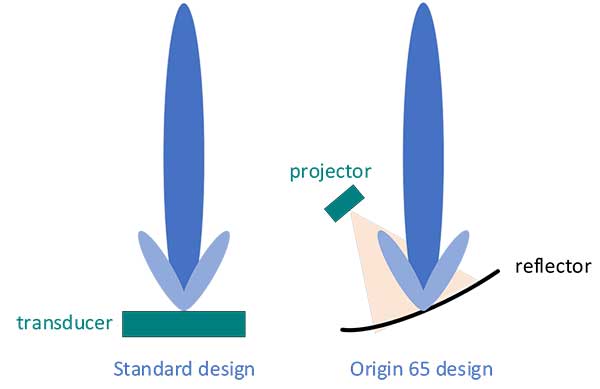
What are the benefits of the Origin 65 ADCP acoustic design?
There are several benefits of the Origin 65 acoustic design.
First, the small projector is more cost‑effective and robust to pressure cycling than large, monolithic transducers – the addition of the parabolic reflector is not a large contributor to cost due to the low price of steel. This translates to lower cost of ownership, and more reliable operations, particularly in deep water.
Second is that making the reflectors is comparatively easy: There is little to go wrong in manufacture and only a single material is used, meaning that the reflector size (which ultimately determines beam width) can be made larger than would be possible with the traditional design. A larger reflector means narrower beams – more power in the direction you want it. Compared to an equivalent monolithic design at 62 kHz, the Origin 65 beams provide an extra 2.5 dB directivity. This means that battery life can be extended as around half the power is required per ping to reach maximum profile range, reducing the number of costly maintenance and battery refurbishment cycles.
Finally, the design makes in‑field repairs easier. Each projector and reflector can be detached from the instrument and replaced. The mechanical tolerance of the projector/reflector, and the instrument itself, is such that beam alignment calibration is not necessary prior to redeployment
Contact [email protected] for more information.
Origin ADCPs have a battery disconnect to preserve battery life.

When the battery disconnect is inserted into an Origin ADCP, all power to the instrument is shut off and the status LED will not flash.
To enable power, unplug the battery disconnect and the status LED will begin flashing. If a measurement schedule was in progress prior to insertion of the battery disconnect, this will be resumed when the disconnect is later removed.
Once you have completed your mission, simply re-insert the battery disconnect to power off your Origin ADCP and preserve its battery.
Contact [email protected] for more information.
Uploading an Edge application to your Origin ADCP is really easy, and in just a few clicks you’ll be ready for deployment. To start, all you need is your Origin ADCP with supplied cable, and a computer.
Launching Origin Portal
With your ADCP powered, connect to your computer with the supplied comms cable and navigate to Origin Portal, the device’s Web UI. Here you can upload your Edge application.

Navigating Origin Portal & uploading an Edge app
After the Origin Portal Web UI has launched, you can import an Edge app previously downloaded to your computer.
It’s as simple as clicking Import and choosing which app you want to use.
Confirmation of successful app upload
You can confirm successful Edge app upload from the Origin Portal Edge page. You are then ready to deploy your Origin ADCP – the Edge app will process the data collected, and you can access the resulting data in a variety of ways – see the “What is Edge functionality” FAQ to find out how.

Contact [email protected] for more information.
Origin 600 has an internal rechargeable battery as standard and recharging it is straightforward. All you need is your Origin ADCP and supplied charger.
How to get started
Once you have recovered your Origin 600 after deployment, you can recharge the device while you download your data.
Simply, locate the charger supplied with the Origin 600 as standard, plug in the power supply and connect to the ADCP by the fast charge port on its endcap.

How long does charging take?
A full charge of the Origin 600 with single battery takes 4-5 hours, but like your smartphone, getting to 80% capacity is much quicker – and then you’re ready to get back in the water. To give you peace of mind, the charge remaining can be queried via the Origin Portal Web UI when cabled, or acoustically through our Origin Topside software – so you always know when it’s time to recharge Origin.
Contact [email protected] for more information.
Why is compass calibration required?
ADCP compass calibration is required to not only correct for location specific magnetic distortions (i.e. distortions caused by changes in the earth’s magnetic strength at various locations), but also to correct for the introduction of new materials with a magnetic signature, e.g. mounting hardware.
When should I perform compass calibration?
Compass calibration is site/installation specific, and therefore should be performed by the user prior to deployment.
Contact [email protected] for more information.