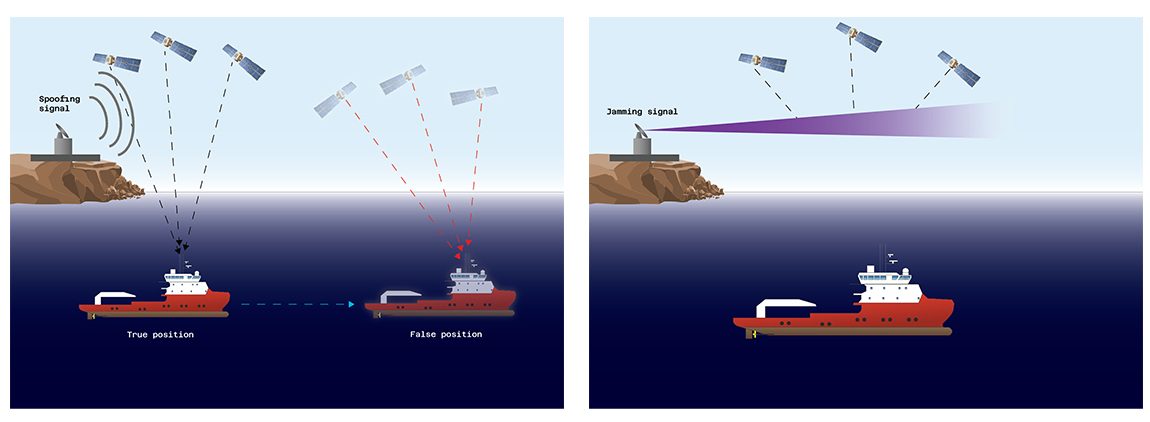
Understanding the differences between jamming and spoofing is essential when dealing with security and interference in maritime communication and navigation systems. Both are forms of interference, but they work in fundamentally separate ways with distinct threats.
What is jamming?
Jamming is the intentional disruption of signals by overwhelming a communication frequency with noise or other signals. This prevents devices, like navigation systems, from properly receiving and transmitting data. It can disrupt satellite signals, affecting a ship’s ability to determine its position, speed or course.
It can also prevent a vessel’s position from being transmitted during an emergency distress call over marine VHF radio and can interfere with radar systems used for navigation, collision avoidance and weather monitoring.
Jamming is considered a brute force attack targeting availability, aiming to deny service rather than manipulate data.
What is spoofing?
Spoofing is when someone tricks a system by sending fake signals. This makes the system show the wrong location or act incorrectly. For example, in GNSS spoofing, false signals can fool navigation systems into thinking they are somewhere they are not. This can cause navigation errors or confusion. Spoofing can also disrupt the timing system on a vessel, now heavily relied on in many marine systems.
Unlike jamming, spoofing needs advanced skills and knowledge of the system being targeted.
Key differences