


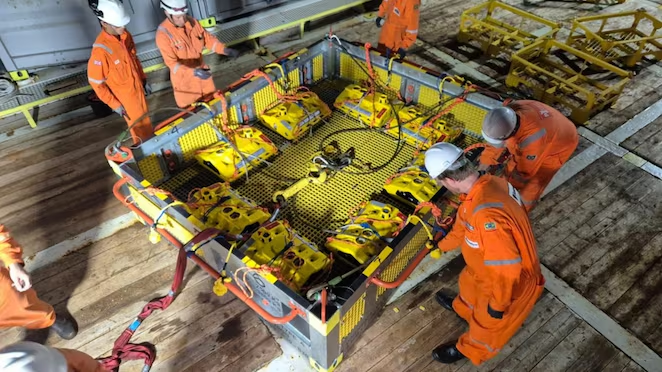
Shell Brasil, Petrobras, SENAI CIMATEC, and Sonardyne complete the first qualification phase of the OD OBN subsea seismic node system with a significant milestone. Scroll down to read this news in Portuguese.
Rio de Janeiro, May 19, 2026 – The Mero Field – located in the Santos pre-salt basin and operated by the consortium comprising Petrobras (38.6%), Shell Brasil (19.3%), TotalEnergies (19.3%), CNPC (9.65%), CNOOC (9.65%), and PPSA (3.5%) – will benefit from a pioneering technology for 4D seismic acquisition, developed through a CENPES RD&I initiative in partnership with Shell, Sonardyne, and SENAI CIMATEC. The first phase of qualification of the On-Demand Ocean Bottom Nodes (OD OBN) system has been completed, with the deployment of 84 units on the seabed at a depth of approximately two thousand meters. This project is funded by Shell Brasil and Petrobras’s CENPES through ANP’s R&D clause, and is being carried out by SENAI CIMATEC and Sonardyne.
The technology was developed to support reservoir management, offering a new alternative for 4D seismic acquisition – a technique used to monitor fluid behaviour within the reservoir. This type of data enables improved decision-making regarding production and fluid injection, contributing to more efficient operations.
The qualification marks a new milestone following eight years of technological development, which included conceptual design, prototype manufacturing, laboratory testing, and over two thousand days of deepwater trials. The deployment enabled validation of the installation system logistics, and, during operations, some equipment underwent validation testing for data transmission via laser-based optical communication.
“The deployment operation of the first 84 OD OBN units from the pilot batch is a highly significant step for both the program and the commercialization of the product. The success of this critical phase is a source of great pride and reflects the maturity achieved throughout development. We continue to advance toward the next stages of this challenging project,” stated Valter Beal, Innovation Project Leader at SENAI CIMATEC.
“Completing the first deployment phase of the OD OBNs at Mero represents a decisive step in the maturation of a technology with strong potential to generate real value for offshore operations. The next stages—seismic acquisition, data retrieval, and interpretation—will follow in the coming months. In partnership with Petrobras, SENAI CIMATEC, and Sonardyne, we aim to transform national R&D into more frequent, accurate, and efficient reservoir decisions, strengthening a more competitive and sustainable pre-salt,” said Manoela Lopes, Technology and Innovation Director at Shell Brasil.
The seismic acquisition and data retrieval phases will conclude the OD OBN qualification. Acquisition will consist of a seismic survey over the monitored area, while retrieval will involve recovering recorded data via optical communication. Data processing and interpretation will follow the standard workflow of a 4D seismic survey, with the objective of assessing system performance and its potential to support reservoir management.
“For the first time, we are developing in Brazil the technology that will enable seismic monitoring of pre-salt fields. This demonstrates that investment in science and technology, through partnerships between companies and research institutions, can foster industrial development in the country,” stated Lílian Barreto, Executive Manager of Cenpes, Petrobras’ Research, Development and Innovation Center. “It is a commercial product with a high technological level that enhances our offshore operational efficiency, reduces operational risks, and contributes to lower-emission operations,” she added.
Sonardyne contributed the through water acoustic and optical communications technologies that enable the nodes to be controlled and data to be retrieved wirelessly in deepwater environments. The company also provides systems integration and engineering capability, and is jointly responsible for manufacturing the pilot OD OBN system in Brazil, together with SENAI CIMATEC.
“Seeing the OD OBN system successfully deployed at Mero is a strong validation of the technology and the collaborative R&D behind it,” says Shaun Dunn, Projects Director, Sonardyne. “We are looking forward to moving to the next phase of the project which involves full commercialization and manufacturing of OD OBNs in Brazil.”
How the technology works
OD OBNs are sensors that capture seismic waves reflected from oil reservoirs. This data is processed in supercomputers, enabling the adjustment of extraction rates and the reinjection of water and gas to stimulate well production. A key differentiator of the developed technology is that the equipment can operate on the seabed for up to five years, at depths of up to 3,000 meters, and can be remotely activated and deactivated. Data extraction is performed through wireless optical communication with subsea vehicles.