


Dynamic Positioning (DP) vessels require multiple independent Position Reference Systems (PRS) to safely maintain station or when they need to manoeuvre in a tightly controlled way. When GNSS is intermittent or unavailable, underwater acoustic positioning provides an independent reference unaffected by satellite signals.
Many operators refer to any acoustic PRS as “HiPAP”. However, HiPAP is just one implementation of one type of acoustic positioning system—not the technology itself (similar to how GPS is just one form of GNSS – global navigation satellite system).
The most common underwater acoustic PRS is USBL (Ultra-Short BaseLine positioning). Sonardyne’s Ranger 2 and Kongsberg’s HiPAP are both USBL systems. They determine the position of a known acoustic transponder by measuring its range and bearing from a hull-mounted transceiver. For DP applications, the transponder is installed on the seabed, providing a fixed reference for station keeping. USBL is mature, accurate and widely deployed across offshore construction, survey and intervention operations.
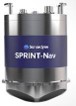
SPRINT-Nav DP is fundamentally different to USBL positioning. It is a hybrid navigation system combining a high-grade Inertial Navigation System (INS) with a Doppler velocity log (DVL) to continuously calculate vessel position and heading. Following initialisation, where it is fed an initial absolute position (which can be from a GNSS input or a fixed seabed or surface position), it maintains a stable position using tightly coupled inertial sensing and DVL velocity measurements, enabling it to ride through GNSS outages.
The key difference is that USBL measures the vessel’s position in relation to the fixed seabed reference transponder, whereas SPRINT-Nav DP calculates the vessel’s position using an acoustic pulse reflected off the seabed, with optional position aiding (e.g. surface, GNSS, seabed) to constrain long-term drift. Both can provide DP PRS inputs, but they do so using fundamentally different techniques, providing operators with different solutions according to the constraints of their particular operating scenarios or environment. SPRINT-Nav DP can be seen as giving vessel operators an additional independent PRS, perhaps for when USBL isn’t practical to implement, with different failure modes and strong resilience during GNSS denial.
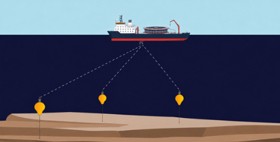
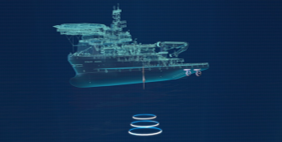
USBL and SPRINT-Nav are hull-mounted systems. Left is a USBL set-up. Right is SPRINT-Nav using DVL.
For offshore operators, the real question is which PRS—or combination of PRS—delivers the highest operational resilience, the lowest mobilisation effort and the greatest confidence that the vessel can continue working safely when satellite positioning cannot be relied upon.
For a more in depth look at different acoustic DP PRS solutions, read our blog, How vessels can hold position when GNSS doesn’t.