


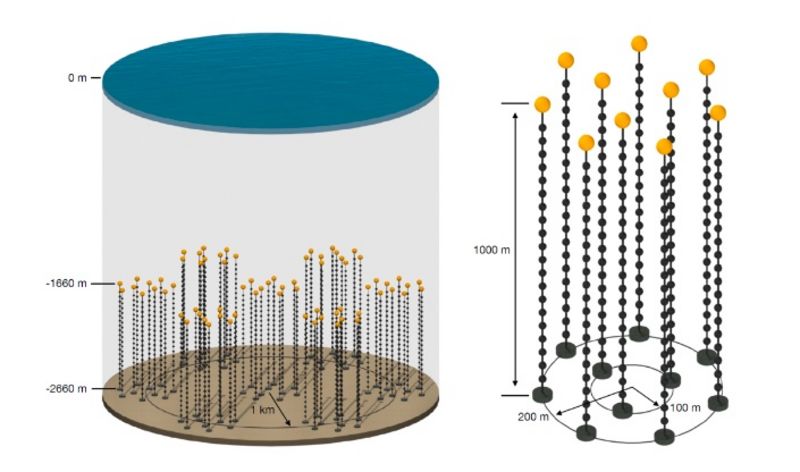
A new, world-class deep-sea neutrino detector being built to transform our understanding of the universe is to use precise positioning from underwater technology company Sonardyne.
An array of Sonardyne’s Fetch instruments will provide the precise and stable underwater positioning the 3,000 m deep Pacific Ocean Neutrino Experiment (P-ONE) needs to accurately detect and analyse high-energy neutrinos.
P-ONE – a multi-national, multi-institute scientific collaborative project – will help scientists to unlock insights into extreme cosmic phenomena like black holes and supernovae.
The next generation cosmic neutrino telescope will be built off the coast of British Columbia, Canada, leveraging Ocean Network’s Canada‘s existing world-class advanced deep-sea infrastructure.
Alongside exploring the universe, P-ONE will also deliver vital data for oceanography, climate science and tectonic research, advancing both astrophysics and marine technology.
Simon Fraser University (SFU), in British Columbia, is one of the collaborators on the P-ONE project and is coordinator of the array’s acoustic positioning.
Professor Matthias Danninger, principal investigator at SFU, says, “The P-ONE collaboration’s goal is to create a unique observational facility, as part of a global effort to improve our understanding of high-energy and ultra-high-energy cosmic neutrinos, their sources and their role in astro and particle physics.
“The positioning system is critical to its success. Critically, we need to know precisely where our detector is in the absolute geo-reference frame and also where each component is relative to each other at any time, as, although anchored the ocean currents will move the detector lines constantly.
“With Sonardyne’s Fetch system, we’ll achieve the precision we need and continuous monitoring to maintain alignment, safeguarding data integrity and enabling P-ONE to unlock insights into extreme cosmic phenomena.”