Across the marine robotics sector, operators face ongoing challenges in achieving precise underwater localisation and robust coordination for autonomous vehicles. Addressing these obstacles is critical for advancing multi-vehicle operations, whether it’s for environmental monitoring, streamlined surveys or a military mission.
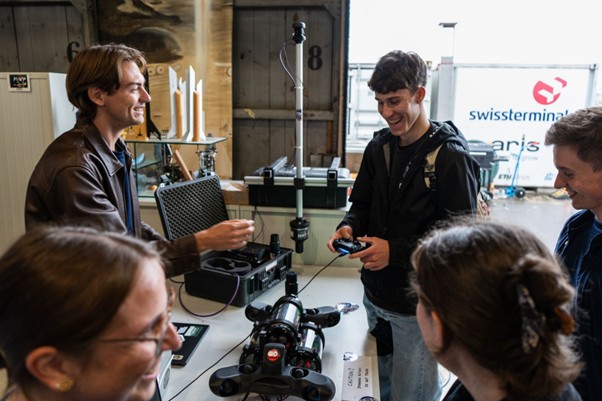
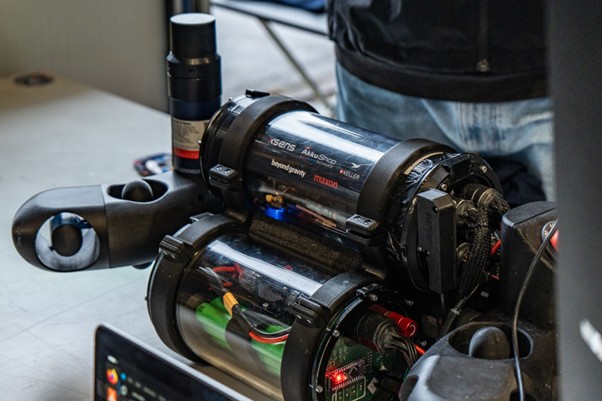
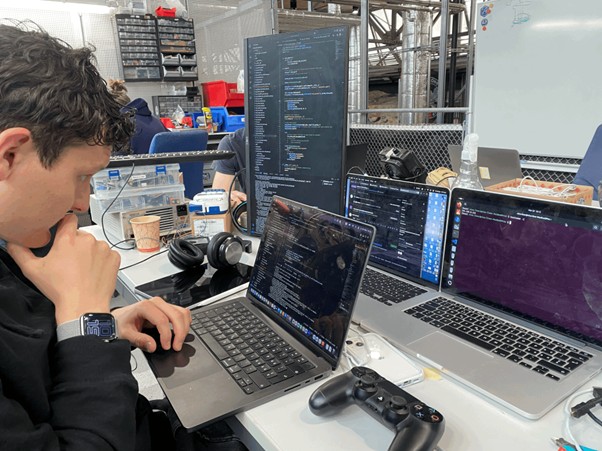
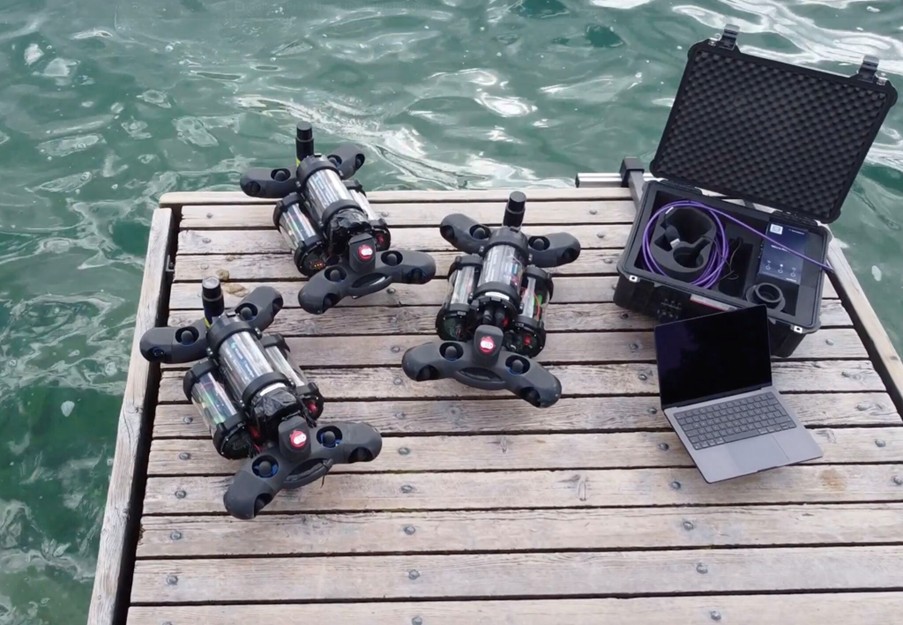
We recently sponsored a team of engineering students at ETH Zürich who are developing underwater swarm capability for 3D environmental sampling in Swiss Lakes. They used our Micro-Ranger 2 with Robotics Pack to develop and demonstrate their robotics.
The challenge
Monitoring environmental pollution in dynamic waters can be challenging, especially using traditional sampling methods from a vessel. This typically involves point sampling, resulting in a limited number of data points, each gathered at a different point in time, hindering spatial and temporal coverage.
The Swiss Federal Institute of Technology’s (ETH Zürich) SWARM team set out to develop a better solution, using underwater robotics. Specifically, they wanted to show how a swarm of drones could gather data simultaneously, across multiple locations, and also move towards where pollutant levels are increasing (gradient tracking) to find the source.